Fish are the slower, lower-maintenance answer to rat ranching. You run a recirculating aquaculture system, or RAS, keep its water, power and filters supplied, and decide what each fish is for: tilapia breed and fill the tank, eels are raised for their fillets, and sturgeon pay in caviar. Water Trading comes first, because Aquaculture cannot be bought without it.
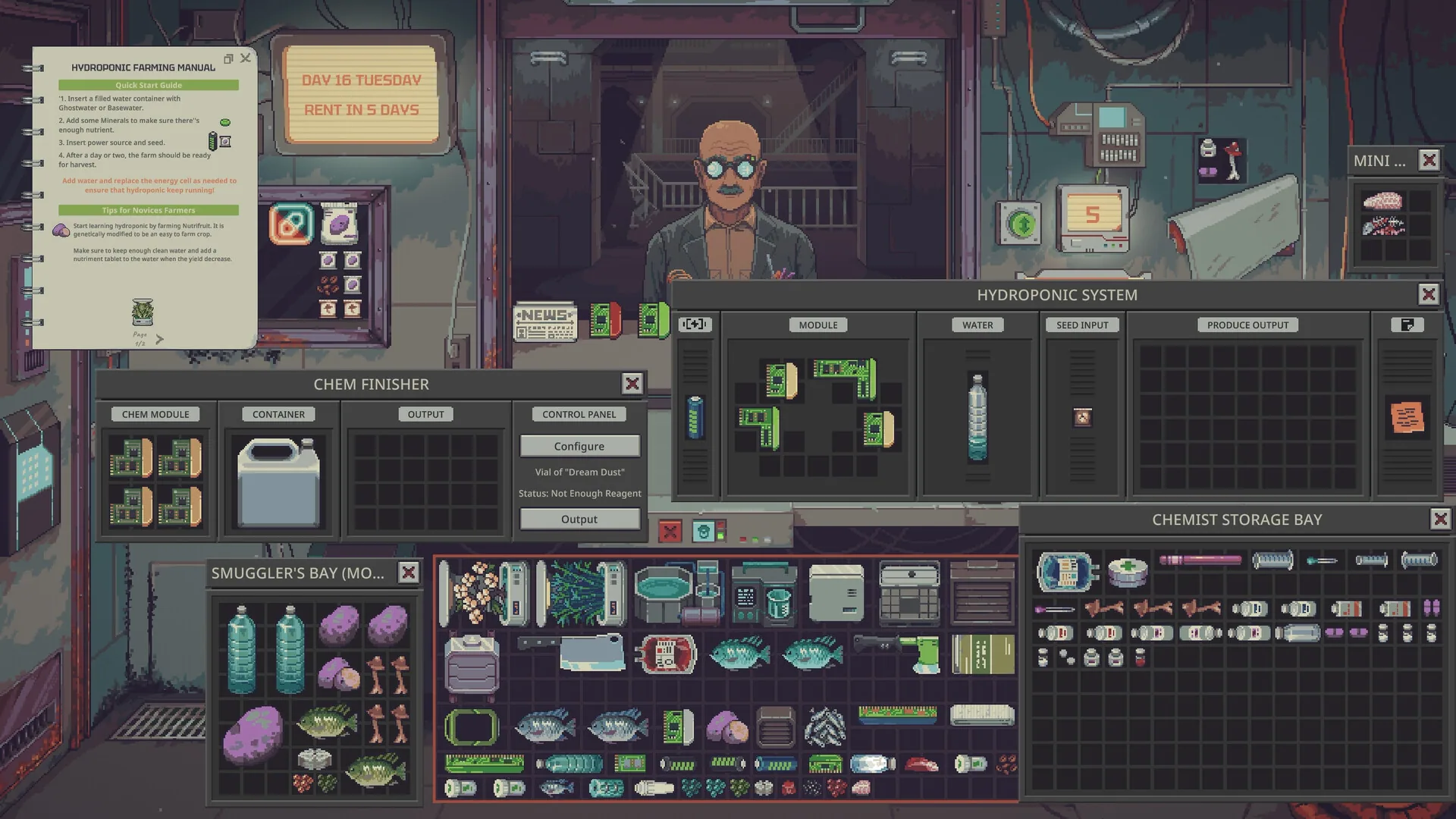
Fish in the stock grid on a Tuesday, the day the Retired Aquafarmer calls.
400Credits for Aquaculture, after Water Trading
6fish species, three of which breed in captivity
12,000 mLheld by the RAS water reservoir
8 × 4starting tank grid, growing to 12 × 8
Setting up a tank
Buy your way in, or start there
Buy Water Trading, then Aquaculture for 400 Credits. The kit arrives at once: a RAS with its tank, fertilized Tilapia roe, an Energy Cell, a jug of Rustwater, fish feed, a Kitchen Knife and a Marking Pen. The Retired Aquafarmer then calls every Tuesday with equipment and roe.
Aquaculture II costs 1,200 Credits more, adds larger fish to those visits and gives you two young eels straight away.
The Aquafarmer scenario is a separate start with its own stock, so read what it hands you instead of assuming the network kit.
Slot the RAS Water Tank into the system, then fill it where it sits. It holds 12,000 mL and stays with the system once fitted, so choose the tank's home first. Add up what your fish need as they grow: an adult tilapia drinks 750 mL, an adult sturgeon 3,000 mL.
Keep power and filters supplied
The tank needs an Energy Cell and filters to keep the loop clean. Each width or height upgrade adds a cell along that axis and raises the night's power draw, while up to 12 power-efficiency upgrades pull it back down.
Stock for the job you want
Tilapia roe is fertilized, hatches to fry and then grows into individual fish. A new tilapia clutch holds six eggs, though not all of them have to survive. Water for roe and fry is counted across the whole clutch; from the juvenile stage on, it is per fish.
Feed to each fish's diet
Tilapia are omnivores, while eels and sturgeon are carnivores, and Industrial Fish Feed only suits omnivores and herbivores. A fish starts looking for food once it drops below 75% of its maximum reserve, so check the dispenser's target and its compatible calories rather than just whether something is in the tank.
Loose canned food is ignored. Loose pellets and feed top a fish up to about 85% of its reserve.
More than a quarter of a fish's calories from Gutterflow Pellets leaves it pellet-tainted, unless it is a Gutter Tilapia.
Keep small fish away from big ones
Any fish that is not a herbivore can eat live stock weighing up to 20% of its own weight, so fry and breeders need their own space. Mark the fish you want to keep: the Auto Butcher works inside a RAS and always skips anything marked.
Reference
The RAS in numbers
Nightly power in kJ is max(1, 5 + 2W + 3H − 2E), where W and H are completed width and height upgrades and E is power-efficiency upgrades, up to 12.
System
Value
Starting grid
8 × 4
Maximum grid
12 × 8
Water reservoir
12,000 mL
Wild's Network unlocks
Unlock
Credits
Water Trading Opens Aquaculture
300
Aquaculture Kit and weekly supplier
400
Aquaculture II Larger fish and two young eels
1,200
A clean-looking tank is not drinking water
Gutter Tilapia tolerate waste and clear some contaminants, but that does not make the reservoir safe to sell or drink. Test anything you take out of it.
Choosing a fish
Adult age is a growth counter, not a promise of nights. Diet, hunger, health and room can all hold a fish back.
Weights are the baseline for each stage rather than a reading of your own fish.
Tilapia and Graft Tilapia
Stage
Age
Weight (g)
Water (mL)
Roe
0
0
100
Fry
1
0
100
Juvenile
3
50
100
Adolescent
5
200
350
Adult
8
450
750
Elder
13
600
1,000
Gutter Tilapia
Stage
Age
Weight (g)
Water (mL)
Roe
0
0
100
Fry
1
0
100
Juvenile
3
50
100
Adolescent
6
200
350
Adult
10
450
750
Elder
16
600
1,000
Eel and Electric Eel
Stage
Age
Weight (g)
Water (mL)
Juvenile
0
150
200
Adolescent
5
600
600
Adult
10
1,400
1,200
Elder
18
2,400
2,000
Sturgeon
Stage
Age
Weight (g)
Water (mL)
Juvenile
0
500
500
Adolescent
10
1,500
1,500
Adult
18
3,500
3,000
Elder
34
5,000
4,000
Harvesting without losing the fish
Knife
Meat
A knife gives meat and related butchery products. Yield depends on the fish, so check the fillet you actually get.
30–75 health
Sturgeon surgery
Surgery Tools take eggs from a living sturgeon. The cost rises from 20% of its 150 health at full eggs to 50% near empty, and surgery is refused unless its health is above that cost.
135 health
Egg recovery
Eggs only grow at 90% health or better, so a sturgeon left weak after surgery stops producing until it recovers.
1 / 2 / 3 kJ
Electric eels
Nightly output at the adolescent, adult and elder stages, sent to the RAS battery and any battery next to it. Starvation stops it, so subtract the feed bill before you count it as spare power.
What each surgery jar holds
The count runs per fish and adds up across harvests. The first 10 jars are caviar, the next six alternate between caviar and ordinary sturgeon roe, and every jar after that is roe, so note how many each fish has already given.
Egg mass (g)
Whole jars
99
0
100
1
199
1
200
2
Jars count whole 100 g units, so 199 g fills only one.
Tank equipment and feed
Add these as the tank fills. Each row links to its item page, with where to get it.