Chemistry runs in a fixed order: measure the inputs, blend and react them at the right temperature, scan the mixture, separate what you do not want, and only then finish the batch. The finisher judges the result by active ingredient against total volume, so a batch can meet its volume and still come out as Junk Grade. Scan before you commit, and check every temperature limit twice.
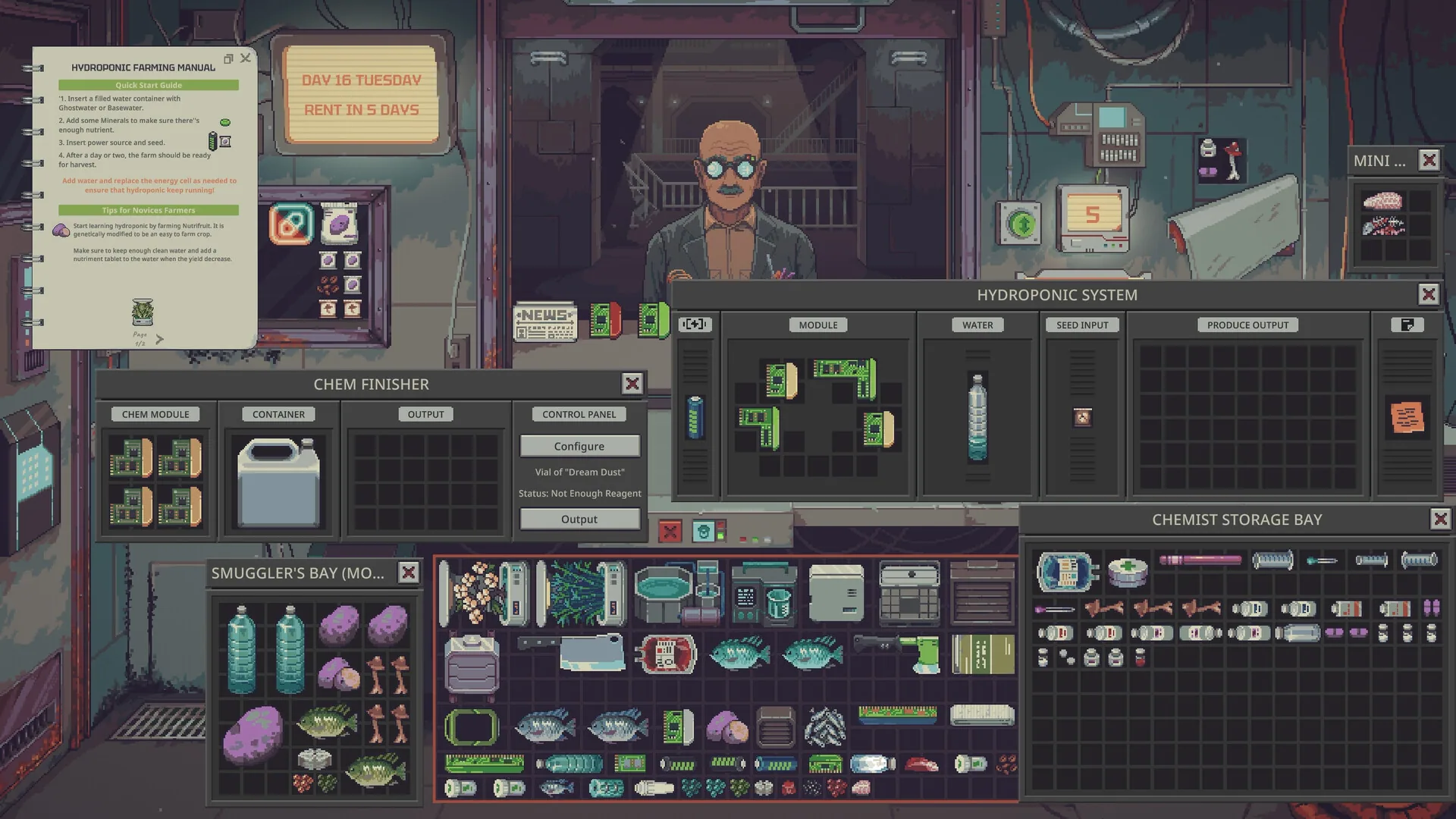
Four modules bring the finisher's loss setting down to 0, but the status still reads Not Enough Reagent: check the container against the recipe's batch volume.
1,000Credits for the Retired Chemist in Wild's Network
7finisher recipes, all needing a dry batch
7product grades, Starch Grade to Lab Pure
99%minimum purity for Lab Pure
The order of work
Set up the bench
Start as the Chemist or pay Joe Wild 1,000 Credits for the Retired Chemist. Both give you a Blender, Heating Plate, Evaporator, Chem Finisher and Composition Spectrometer, and the referral adds droppers, measuring cylinders, Bottled Water, Common Chemical Supplies and Coffee Beans.
The Retired Chemist calls the next day, then every Tuesday, with chemical supplies and equipment.
The Chemist Storage Bay only holds chemistry gear and supplies, which keeps a growing bench tidy.
Recipe volumes are true millilitres. The game counts thousandths of a mL internally, but a 2 mL requirement still means 2 mL, not 2,000. Keep a suitable container for each step, because liquid vessels are not interchangeable.
Blend, then react with heat
Blend the raw ingredient into a suitable vessel and check it has turned to mush. Add water or alcohol, then bring it up to the reaction's temperature on the Heating Plate. Each reaction has its own window, and more heat is not a universal speed-up.
Scan before you commit
Use the Composition Spectrometer to read composition and temperature. Heating, evaporation and blending are different operations, so scan after each one instead of assuming what happened.
Separate what you do not want
Put the mixture in the Evaporator with a receiving vessel in its distillate slot. It runs overnight and removes every evaporative component in proportion, not just the one you are after. Scan again once it finishes.
The Evaporator Solvent Recovery Module limits what you recover to alcohol, but evaporation still takes the same components out of the input.
Finish and read the grade
Select the recipe in the Chem Finisher and meet its batch volume with a dry mixture. If it will not start, check the recipe, the volume and the wet or dry state, then power and output space. Inspect the output, because the finisher adds contamination of its own.
Purity is active ingredient divided by total product volume. Each figure is the minimum for that grade.
Grade
Minimum purity
Lab Pure
99%
Pharma-Grade
90%
Near Pharma
80%
Street Standard
60%
Cut Product
45%
Junk Grade
30%
Starch Grade
0%
Finisher loss by modules
Upgrade modules
Loss setting
0
12
1
6
2
3
3
1
4 or more
0
Chemicals bring addiction
Every product line carries its own risk, and for chemicals that risk is addiction. A reference price is not an offer either, so check what buyers actually pay before you plan around it.
Finisher recipes
Every recipe needs a dry batch. Batch size is the volume the finisher takes per unit, and base value is a reference price, not a sale offer.
Temperatures are the working window for each reaction. Scan the composition before every finish.
80°C or 50°C
Coffee to caffeine
Blend Coffee Beans to mush and add water. Water extraction needs at least 80°C; the alcohol route starts at 50°C, and the two solvents may not give the same yield. The reaction leaves caffeine and plant matter.
40–59°C
Dream Cap to Dream Dust
Blend uncooked Dream Cap, add alcohol and heat to 40°C or above. Stay below 60°C, where the extract starts to degrade. Alcohol at five times the mush gives the best extract fraction.
40–49°C
Nightmare Cap to Nightmare Dust
Mix mash with alcohol and heat to at least 40°C. A 5:1 ratio reaches the extraction cap of 0.5, and more alcohol adds nothing. Keep the extract below 50°C, where it degrades faster the hotter it gets.
45–55°C
Dream extract to Nomore
React Dream Cap extract with reducing agent and Lipobond, with alcohol at 10% of the volume or less. It runs faster from 50°C. One part Lipobond to four of extract hits the rate cap, and the output is 60% Nomore to 40% debris.
110–129°C
Methylol to Fantyl
Combine Methylol and reducing agent, which reacts faster from 120°C. Stabilizer protects an equal amount of Methylol, so a batch with as much stabilizer as Methylol never reacts. At 130°C and above, Fantyl loses 2% per heat check.
Cleaning up a batch
Reagents change what is in the vessel rather than making impurities disappear. Run a small test batch, then scan it again before you relabel anything.
Sedimentation
Stabilizer with acid or base makes debris, an acid and base imbalance can turn protein into debris, and Lipobond turns fat into debris. Filter the debris out, and avoid adding every cleaner at once.
Heat and microbes
From 70°C a heat check leaves 80% of the microbes, and at 100°C it clears them all. Alcohol-based removal needs at least 40% alcohol by volume.
Heat and waste
Organic waste starts changing at 80°C. Below 100°C one check processes 15%, and at 100°C all of it, with about a third of what is processed becoming physical contamination.
Mixture
After one check
40 mL waste + 1 mL acid
All 40 mL processed into 4 mL mineral, using 1 mL acid
20 mL microbes + 1 mL acid
All 20 mL removed, using 0.2 mL acid
0.5 mL acid + 0.5 mL base
Both consumed
8 mL fat + 1 mL Lipobond
1.8 mL debris from 1.6 mL fat and 0.2 mL agent
In a mixed batch, earlier reactions change what is left for later ones, and neutralization runs after mineralization, microbe removal and sedimentation.
The chemistry bench
Open any row for its sources and the buyers who take it.